
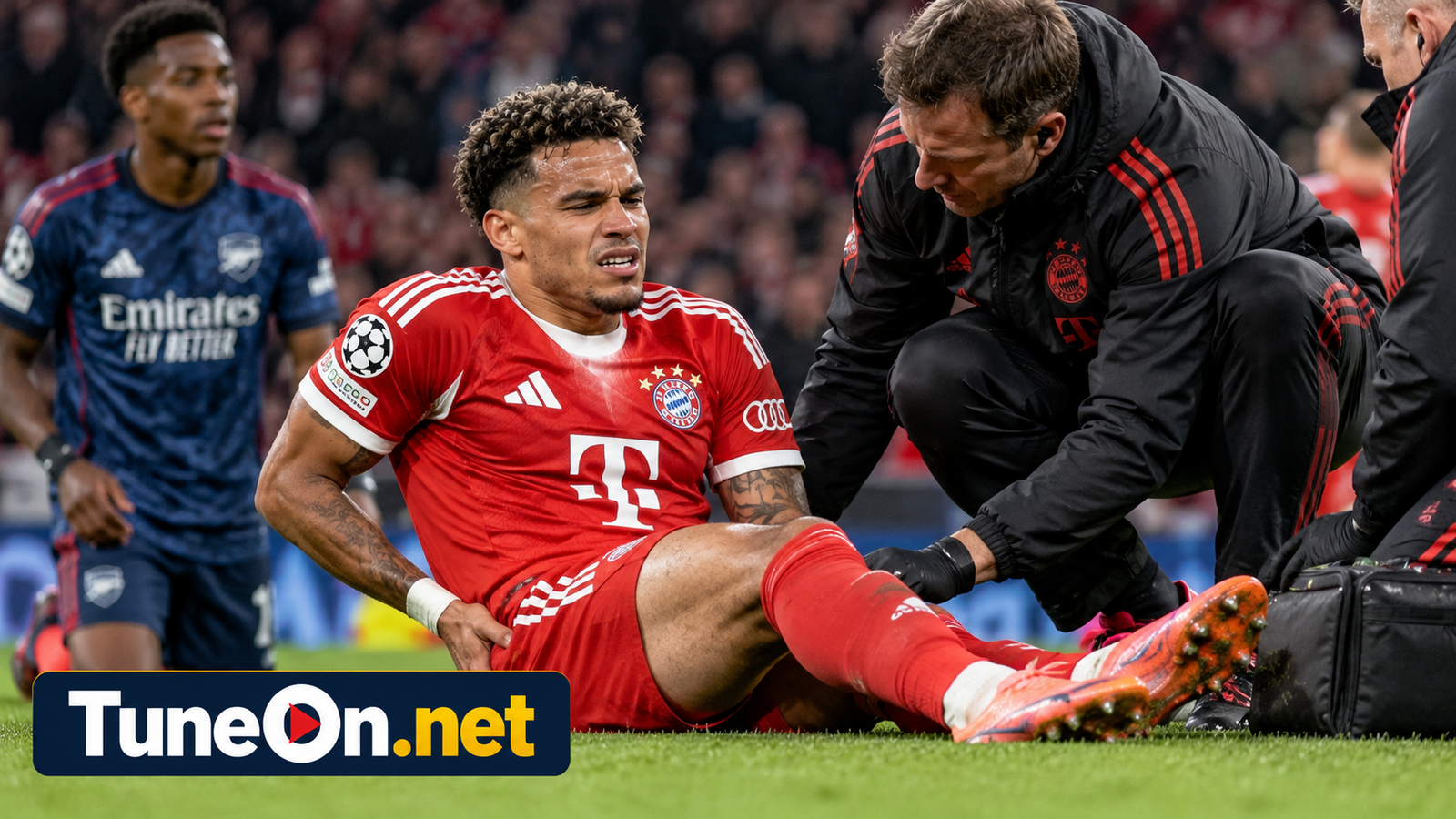
Luis Díaz is pictured receiving medical attention after suffering a hamstring injury during Bayern Munich’s Champions League match against Arsenal.
Bayern Confirm Luis Díaz Hamstring Injury After Arsenal Draw
The new story is confirmed: Bayern Munich say Luis Díaz has suffered a minor tear in his left hamstring during the 2–2 Champions League draw with Arsenal on October 21, 2026. The club has not announced a specific return date, saying he will be sidelined for the time being. Díaz came on in the 68th minute and left the field in stoppage time.
I’ll keep this article distinct from the earlier Bournemouth–AC Milan coverage. One important note: I can provide the article and SEO fields, but I can’t responsibly invent 3–5 internal URLs for your website. I’ll include clearly marked internal-link opportunities that can be replaced with real site links.
Below is a full article draft with the focus keyword naturally placed in the headline, introduction, subheadings, meta description, URL suggestion and FAQ. I’ve kept the injury timeline factual: Bayern has not confirmed an exact recovery period. Some reports speculate about weeks, but that should not be presented as the club’s official diagnosis or timeline.
Bayern Confirm Luis Díaz Hamstring Injury After Arsenal Draw
News article | Football | Bayern Munich | UEFA Champions League
Bayern Munich have confirmed that Luis Díaz has suffered a minor tear in his left hamstring following the club’s dramatic 2–2 draw with Arsenal in the UEFA Champions League. The Colombian winger will be sidelined for the time being, leaving Bayern to assess how his absence could affect their attacking options during a busy run of fixtures.
Díaz entered the match as a second-half substitute but was unable to finish the contest. Bayern’s medical team examined the player and confirmed the injury after the game. The club has not announced a firm date for his return, meaning his recovery will be monitored before a decision is made about when he can resume full training.
The Luis Díaz hamstring injury is an unwelcome development for Bayern, who had hoped to take maximum points from their meeting with Arsenal. The match ended in a 2–2 draw after the German side surrendered a late lead, and the injury added another concern to a night that had already tested the team.
The winger’s absence could affect Bayern’s choices on the flanks, particularly as the club moves into another demanding period of domestic and European football. However, the exact impact will depend on the length of his recovery and how quickly the team’s other attacking players can take on additional responsibilities.
Bayern Munich Confirm Luis Díaz Has a Hamstring Tear
Bayern Munich announced that Díaz had sustained a minor muscle tear in his left hamstring during the Champions League match against Arsenal. The diagnosis followed medical examinations conducted by the club’s medical staff.
The phrase “minor tear” provides an indication of the injury’s nature, but it does not automatically establish a precise recovery schedule. Hamstring injuries can vary in severity, and the return of a professional footballer depends on more than the initial description of the damage.
Bayern have said Díaz will be out for the time being. That wording means the club has not yet set a confirmed return date. It also leaves room for further updates once the player has progressed through the early stages of rehabilitation.
For supporters, the main question is how long Bayern will have to operate without one of their attacking options. At this stage, the safest conclusion is that Díaz is unavailable until the club’s medical team considers him ready to return.
The official announcement is important because it separates confirmed information from speculation. Reports suggesting a particular number of weeks may offer an estimate, but the club’s medical assessment remains the primary source for the player’s status.
How Luis Díaz Sustained the Injury Against Arsenal
Díaz began the match on the bench and was introduced in the 68th minute. He entered as Bayern looked to strengthen their attacking play during the second half of a high-intensity European contest.
The winger was involved in the closing stages, but his appearance was cut short when he was forced off in stoppage time. Bayern subsequently confirmed that the problem was a minor tear in his left hamstring.
The timing was particularly frustrating. Díaz had only been on the pitch for a relatively short period, yet the injury prevented him from seeing out the match. His substitution also meant Bayern had to adjust their attacking personnel during the final moments.
The match itself was closely contested. Arsenal took the lead through Eberechi Eze, while Alphonso Davies brought Bayern level. Harry Kane then put the home side ahead from the penalty spot before Declan Rice scored a late equaliser for Arsenal.
Bayern’s official match report records Díaz as a second-half substitute who was replaced in the closing stages. The final score was 2–2, with both teams sharing the points.
What Is a Hamstring Injury?
The hamstrings are a group of muscles located at the back of the thigh. They play a central role in running, accelerating, slowing down and changing direction—movements that are repeated frequently during football matches.
A hamstring strain or tear occurs when muscle fibres are damaged. The injury can happen during a sprint, a sudden change of pace, a sharp movement or an action that places considerable force on the back of the thigh.
Footballers rely heavily on their hamstrings because the muscles help control the leg as it moves through a running stride. They also contribute to explosive acceleration, which is essential for wingers such as Díaz.
The severity of a hamstring injury can range from a mild strain to a more significant tear. The initial symptoms and medical examination help determine the extent of the damage, while further assessment and rehabilitation progress guide the return-to-play decision.
A player may be able to walk comfortably before being ready to sprint or compete at the intensity required in a Champions League match. That is why recovery cannot be judged solely by whether the footballer appears pain-free during everyday activities.
In Díaz’s case, Bayern have described the injury as a minor tear in the left hamstring. The club has not publicly provided detailed imaging results or a precise rehabilitation schedule.
Why the Injury Matters for Bayern Munich
Díaz brings pace, direct running and the ability to challenge defenders in one-on-one situations. Those qualities can help Bayern stretch opposition defences and create space for teammates in central areas.
His absence may require Bayern to adjust how they attack from the wide positions. The coaching staff could use another winger, move a player into a different role or change the balance of the forward line depending on the opponent.
The injury does not necessarily mean Bayern will struggle in every match. The squad has several attacking options, and the manager can adapt the team’s approach. Nevertheless, losing a player who can carry the ball forward and attack space is a notable setback.
A winger’s contribution is not limited to scoring goals or providing assists. Direct runs can force defenders to retreat, create passing lanes and open opportunities for midfielders to arrive in advanced positions. Díaz’s availability can therefore influence the overall structure of Bayern’s attack.
The club will need to assess its options carefully while the Colombian works through his recovery. Whether his absence becomes a short interruption or a longer challenge will depend on how the injury responds to treatment and rehabilitation.
Bayern’s Attacking Options During Díaz’s Absence
Bayern have several ways to respond to the injury. The club could maintain its usual system and use another wide attacker, or it could adjust the formation to make better use of the players available.
The decision will depend on the opponent, the condition of the squad and the tactical demands of the upcoming fixtures. A replacement does not need to reproduce every aspect of Díaz’s game to help the team. Bayern may instead distribute his responsibilities among several players.
One option is to use a winger who offers a different style. A player who prefers to receive the ball to feet may help Bayern maintain possession, while a more direct runner could preserve the threat of attacking space behind the defence.
Another possibility is to use a full-back or midfielder in a wider role, depending on the team’s formation. Such a change could affect defensive coverage, so Bayern’s coaching staff would need to consider the balance between attacking ambition and protection against counter-attacks.
The team may also rely more heavily on combinations through the middle. With a central striker and creative midfielders available, Bayern can still build attacks through short passing, movement and overloads even if one of their wide options is missing.
The club’s depth will be tested, but the injury does not force Bayern into one specific tactical solution. The next few matches may reveal how the coaching staff intends to manage the situation.
The Importance of Díaz’s Recovery Process
Hamstring rehabilitation typically progresses through stages. The initial priority is to assess the injury and manage symptoms. The player then works toward restoring movement, strength and confidence before returning to high-speed running.
A footballer must be able to perform explosive actions before being considered ready for competitive action. These include sprinting, accelerating, decelerating, changing direction and responding to pressure from opponents.
The rehabilitation process is usually guided by medical and performance staff. They monitor the player’s response to training and may adjust the workload if symptoms return or progress is slower than expected.
A cautious approach can be important because returning too early may increase the risk of aggravating the injury. The objective is not simply to get the player back onto the pitch quickly but to make sure he can perform at the required level.
Bayern have not disclosed the details of Díaz’s individual rehabilitation plan. It would therefore be premature to state which stage he has reached or when he will be cleared for team training.
Supporters should look for official updates rather than relying on a fixed timeline based on the phrase “minor tear.” The club may provide more information as the player progresses.
What the Injury Means for Bayern’s Upcoming Fixtures
The timing of Díaz’s injury creates a challenge because Bayern are entering a period in which matches can arrive with limited recovery time between them.
When a team is competing in both domestic and European competitions, squad management becomes especially important. Coaches must consider player fitness, rotation and tactical preparation while trying to maintain results.
Díaz’s absence could reduce the number of available options for wide positions. That may lead to more responsibility for teammates who are already involved in regular match action.
Bayern’s next fixtures will also provide an opportunity to assess the team’s depth. If the club can maintain its attacking output without Díaz, it may reduce the immediate pressure surrounding the injury. If the team struggles to create chances from wide areas, the absence could become more noticeable.
However, the impact should not be judged only by results. The quality of the opposition, match conditions, tactical choices and the availability of other players can all influence performance.
Bayern will need to manage the situation on a match-by-match basis until Díaz is ready to return.
The 2–2 Draw With Arsenal: A Difficult Night for Bayern
The Champions League meeting with Arsenal produced an entertaining contest at the Allianz Arena. Bayern and Arsenal exchanged goals, with the German side taking the lead before the visitors secured a late equaliser.
Eberechi Eze opened the scoring for Arsenal in the first half. Bayern responded through Alphonso Davies, who finished after a pass from Harry Kane. The match remained closely balanced, with both sides creating opportunities.
Kane then converted a penalty to give Bayern a 2–1 advantage. Arsenal continued to push forward and found the equaliser through Declan Rice, whose goal ensured the visitors left Munich with a point.
Bayern had reasons to be disappointed with the result because they had been ahead late in the match. The injury to Díaz added to the frustration, particularly because he had entered the game as a substitute and was forced off before the final whistle.
The draw also highlighted how small moments can influence major European matches. Bayern had chances to strengthen their position, but Arsenal remained competitive and took advantage of an opportunity late in the contest.
The official Bundesliga report also confirmed the 2–2 result and identified Davies, Kane, Eze and Rice as the goalscorers.
“The Bundesliga match report also confirms the result and the goals scored by Alphonso Davies, Harry Kane, Eberechi Eze and Declan Rice.”
Why Bayern Must Avoid Rushing the Winger Back
The temptation to bring an important attacker back quickly can be strong, especially during a congested fixture schedule. However, hamstring injuries require careful management because the muscle is involved in nearly every high-speed running action.
A player may feel ready to return before the muscle has regained the strength and tolerance needed for competitive football. Training and match conditions place different demands on the body, particularly when the player must repeatedly sprint and change direction.
Bayern’s medical staff will need to consider Díaz’s physical progress and his response to increasing training loads. The club may also need to assess whether he can complete full sessions without discomfort before he is considered for selection.
The phrase “for the time being” does not confirm that the player will miss a particular number of matches. It indicates that he is unavailable until further assessment and recovery allow the club to make a decision.
For Bayern, the priority should be ensuring that Díaz returns when he is medically ready. A measured approach can help protect the player’s long-term availability and give the team a better chance of having him fit for the remainder of the season.
What Bayern Supporters Should Watch for Next
The next official update from Bayern will be important. Supporters should pay attention to whether the club provides further details about the injury, the player’s rehabilitation or his return to team training.
A return to individual training would not automatically mean Díaz is ready to play. Players often complete separate conditioning work before joining the full squad, and additional steps may be required before they are considered for a match.
The most meaningful signs of progress would include a return to team sessions, completion of high-intensity training and confirmation that the player is available for selection.
Until then, Bayern supporters should avoid treating unofficial recovery estimates as confirmed news. The club’s medical staff will have the most direct information about the injury and the player’s progress.
The situation could develop as further assessments are completed. For now, the confirmed position is that Díaz has suffered a minor tear in his left hamstring and will be sidelined for the time being.
Conclusion: Bayern Face an Uncertain Wait for Luis Díaz
Bayern Munich’s confirmation of the Luis Díaz hamstring injury provides clarity about the problem that forced the winger off during the 2–2 Champions League draw with Arsenal. The Colombian sustained a minor tear in his left hamstring, and the club has said he will be unavailable for the time being.
The injury is a setback for Bayern because Díaz offers pace, direct attacking movement and an ability to trouble defenders in wide areas. His absence could influence the club’s tactical choices during a demanding stretch of fixtures.
However, Bayern have not announced a precise recovery period. Any estimate of how many matches he may miss should be treated cautiously until the club provides an official update.
The immediate focus will be on rehabilitation, fitness progression and ensuring that Díaz returns only when he is ready to compete. Bayern will need to manage their attacking options in the meantime, while supporters wait for further news about the winger’s recovery.
For now, the key facts remain straightforward: Díaz was injured against Arsenal, medical examinations confirmed a minor left hamstring tear, and Bayern have not set a return date.
“Bayern Munich’s official match report provides the full account of the 2–2 draw with Arsenal, including the goals and substitutions.”
Frequently Asked Questions
What injury has Luis Díaz suffered?
Luis Díaz has suffered a minor tear in his left hamstring. Bayern Munich confirmed the diagnosis after the winger was injured during the 2–2 Champions League draw with Arsenal.
When did the Luis Díaz hamstring injury happen?
The Luis Díaz hamstring injury occurred during Bayern Munich’s Champions League match against Arsenal on October 21, 2026. Díaz came on in the 68th minute and was forced off in stoppage time.
How long will Luis Díaz be out?
Bayern Munich have said Díaz will be sidelined for the time being, but the club has not confirmed an exact return date. Recovery estimates reported elsewhere should not be treated as official unless Bayern confirms them.
Will Luis Díaz miss Bayern Munich’s next match?
Díaz is unavailable while he recovers from the hamstring tear. Bayern’s medical staff will determine when he can return, and the club has not announced a confirmed date for his comeback.
What does a minor hamstring tear mean?
A minor hamstring tear means some muscle fibres at the back of the thigh have been damaged. The severity and recovery time depend on the injury’s exact nature and how the player responds to rehabilitation.
Why is Luis Díaz important to Bayern Munich?
Díaz provides pace, direct running and attacking threat from wide positions. His movement can stretch defences, create space for teammates and help Bayern progress the ball into dangerous areas.
Did Bayern Munich draw with Arsenal?
Yes. Bayern Munich drew 2–2 with Arsenal in the Champions League. Alphonso Davies and Harry Kane scored for Bayern, while Eberechi Eze and Declan Rice scored for Arsenal.
Where can supporters find updates on Luis Díaz’s injury?
Supporters should follow official Bayern Munich announcements and reliable sports news outlets. The club’s medical updates are the best source for confirmed information about the injury and the player’s return.
About the Author