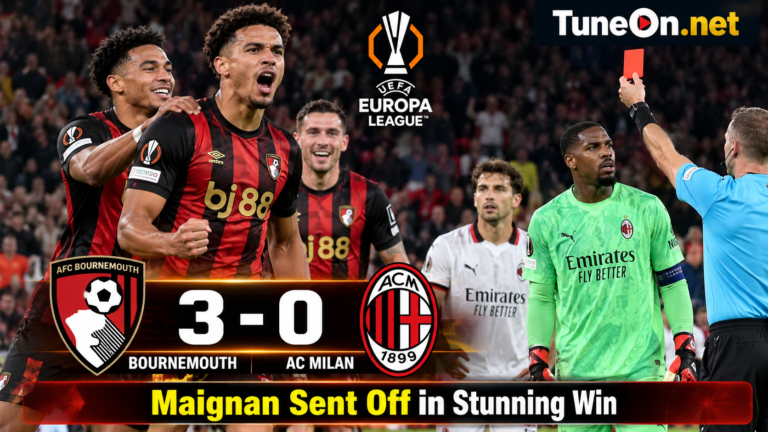

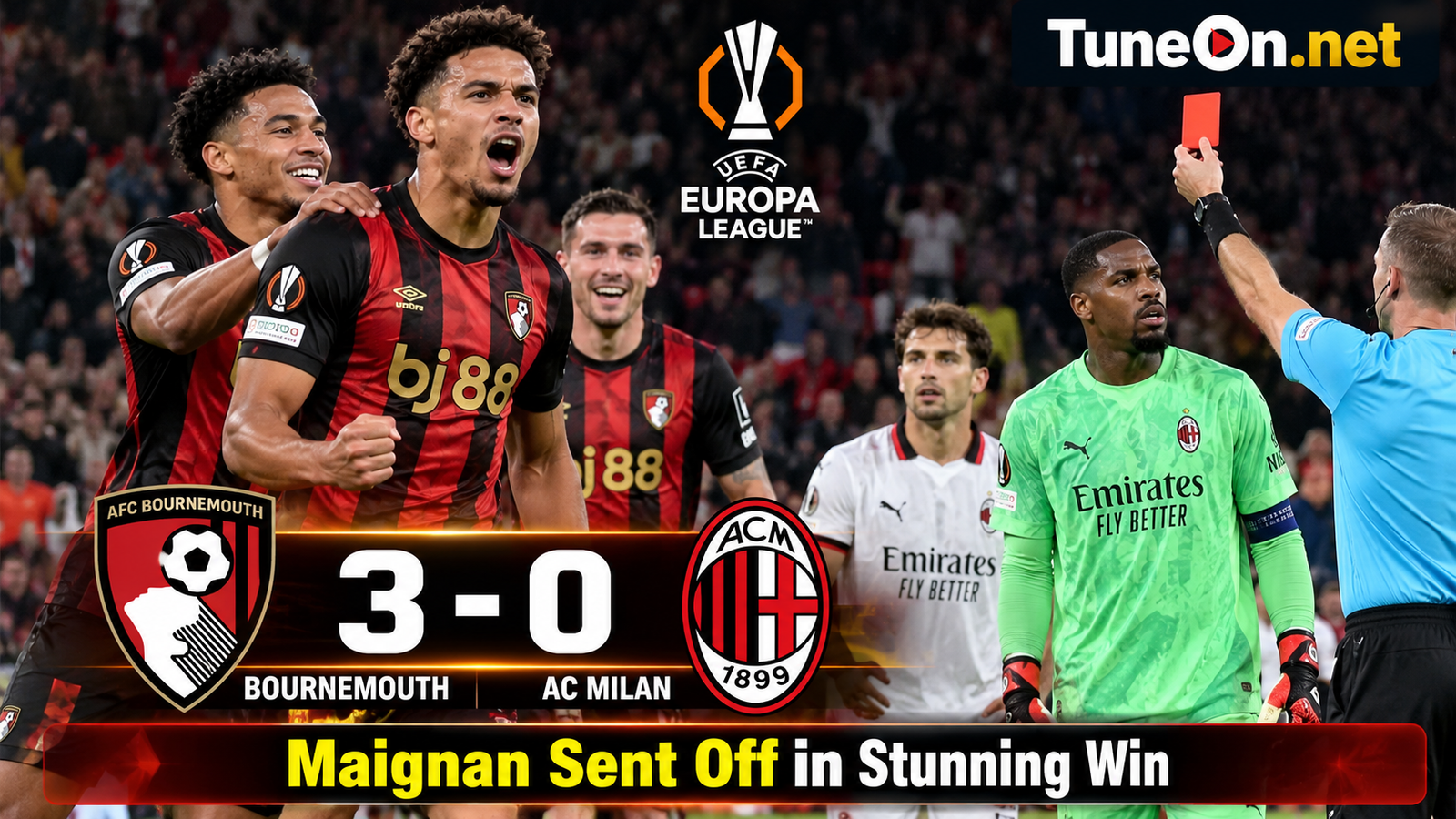
Bournemouth celebrate their 3–0 victory over AC Milan after Mike Maignan’s first-half dismissal.
Bournemouth 3-0 AC Milan: Maignan Sent Off as Cherries Celebrate Memorable European Night
Bournemouth produced a performance to remember by defeating AC Milan 3–0 in a dramatic Europa League encounter on October 22, 2026. The English side took full advantage of a difficult evening for the Italian giants, with Milan goalkeeper Mike Maignan sent off in the first half after a confrontation involving Bournemouth midfielder Tyler Adams.
The result was a major moment for Bournemouth, a club whose journey through English football has included financial uncertainty, lower-league struggles and a remarkable rise to the top level. Beating a club with AC Milan’s European history was an achievement that supporters will remember for years.
The match was shaped by a combination of Bournemouth’s attacking pressure, key penalty decisions and Milan’s inability to maintain discipline. Justin Kluivert and Marcus Tavernier scored from the penalty spot before Amine Adli added a second-half goal to complete the 3–0 victory.
For Milan, the defeat raised difficult questions about defensive organisation, discipline and the team’s ability to respond when a match turns against them. For Bournemouth, it was a statement that the club could compete with a recognised European heavyweight.
Bournemouth 3-0 AC Milan: Match Summary
Bournemouth began the match with energy and confidence, looking to put Milan under pressure rather than allowing the visitors to settle into their preferred rhythm. The home side’s approach helped create an intense atmosphere, with Bournemouth pressing aggressively and trying to force mistakes in dangerous areas.
Milan, meanwhile, struggled to establish control. The Italian side found it difficult to deal with Bournemouth’s movement and pressure, and the match soon developed into a challenging contest for the visitors.
The opening goal came from the penalty spot after a VAR review identified a handball incident involving Milan defender Koni De Winter. Justin Kluivert stepped forward and converted the penalty, giving Bournemouth an important advantage.
The game became even more complicated for Milan when goalkeeper Mike Maignan was dismissed in the first half. The red card followed an incident involving Tyler Adams, leaving the visitors with ten players and forcing them to reorganise.
Marcus Tavernier converted another penalty to extend Bournemouth’s lead. With Milan reduced to ten men and trailing by two goals, the task became increasingly difficult.
Bournemouth continued to apply pressure after the interval. Amine Adli eventually sealed the result with a second-half free-kick, completing a convincing 3–0 victory.
The result was not simply about the scoreline. Bournemouth showed the ability to respond to a major European challenge with confidence, composure and an effective attacking approach.
Justin Kluivert Gives Bournemouth the Early Advantage
Justin Kluivert played a crucial role in Bournemouth’s victory, helping the home side establish control through a first-half penalty.
Penalty opportunities can change the direction of a football match, particularly when the teams are still trying to understand each other’s tactical approach. Bournemouth’s opening goal gave the home players confidence and forced Milan to respond.
Kluivert’s responsibility was significant. A penalty is often described as a straightforward scoring opportunity, but the pressure can be considerable when a match is important and the goalkeeper is experienced.
The Bournemouth attacker kept his composure and converted the opportunity. His goal gave the Cherries a lead that reflected their positive start and placed Milan under immediate pressure.
For Bournemouth, the opening goal was important because it rewarded the team’s attacking intent. Rather than sitting back and waiting for Milan to make mistakes, the home side continued to look for opportunities to move forward.
The goal also changed the psychological balance of the contest. Milan had arrived with the expectation of competing for a positive result, but Bournemouth’s early advantage forced the visitors to chase the game.
That situation became even more difficult when the red card followed.
Mike Maignan Red Card Changes the Match
The most significant moment of the encounter came when AC Milan goalkeeper Mike Maignan received a red card in the first half.
Maignan is widely recognised as an important figure in Milan’s defensive structure. His role extends beyond stopping shots: he also organises the defence, communicates with defenders and helps the team build attacks from the back.
Losing a goalkeeper during a match can have a major effect on a team’s tactical plan. The manager must decide whether to introduce a substitute goalkeeper, which outfield player to remove and how to reorganise the remaining players.
Milan’s dismissal meant that the visitors had to continue with ten players. That placed additional pressure on the defence and reduced the team’s options in attack.
The incident involved Bournemouth midfielder Tyler Adams. Reports described Maignan’s dismissal as following a confrontation in which the goalkeeper shoved Adams. The decision became a defining moment of the match.
The red card did not automatically guarantee Bournemouth a victory, but it gave the home side a major numerical advantage. Bournemouth could now use the extra player to stretch Milan’s defensive shape, move the ball into wider areas and create pressure around the penalty area.
For Milan, the challenge was to remain organised and avoid allowing the situation to become worse. The visitors needed to defend compactly, limit Bournemouth’s opportunities and look for chances to counterattack.
However, the combination of the early goal and Maignan’s dismissal made the task extremely difficult.
Marcus Tavernier Converts the Second Penalty
Marcus Tavernier played an important role in extending Bournemouth’s lead after the team received another penalty.
The second penalty increased the pressure on Milan and gave Bournemouth greater control of the match. Tavernier converted the opportunity, putting the Cherries two goals ahead.
At that stage, Bournemouth had established a strong position. Milan were trailing by two goals and had lost their goalkeeper, meaning the visitors needed to find a way to recover while also protecting their defensive structure.
The second goal was particularly important because it reduced the possibility of Milan returning to the match with a single attacking moment. A two-goal deficit is difficult to overcome when a team has a full complement of players; it becomes even more challenging when playing with ten.
Bournemouth’s ability to convert the penalty also demonstrated the importance of taking advantage of major opportunities. In European football, matches can be decided by small moments, and failing to convert a penalty can give the opposition renewed confidence.
Tavernier’s goal ensured that Bournemouth maintained their advantage and moved closer to a memorable result.
The Cherries still needed to manage the remainder of the match carefully. Milan have a long history of competing in difficult European situations, and Bournemouth could not afford to assume that the contest was finished.
Amine Adli Seals Bournemouth’s 3–0 Victory
Amine Adli completed Bournemouth’s victory with a second-half free-kick.
The goal provided a fitting conclusion to a match in which Bournemouth had taken advantage of key moments and maintained pressure on a struggling opponent.
Free-kicks can be valuable opportunities in football because they allow a team to create a scoring chance without needing to build an attack through open play. A well-executed set piece can punish defensive mistakes and add to the pressure on a team already struggling to recover.
Adli’s goal made the scoreline 3–0 and effectively ended Milan’s hopes of producing a comeback.
The second-half goal was also important for Bournemouth’s confidence. The team had already taken advantage of the penalties and Maignan’s dismissal, but adding a third goal demonstrated that the home side continued to pursue the result.
For the supporters, Adli’s contribution was part of a night that could become a landmark in the club’s European history.
The final score reflected Bournemouth’s ability to capitalise on the match’s key moments. Milan, meanwhile, were left to consider how a contest that began with the possibility of a competitive European performance turned into a heavy defeat.
Why Bournemouth’s Victory Was So Significant
Bournemouth’s 3–0 win over AC Milan was significant because of the contrast between the clubs’ histories and European experience.
AC Milan are among the most decorated clubs in European football. Their reputation has been built through domestic success, European trophies and generations of recognised players.
Bournemouth’s journey has been different. The club has experienced financial difficulties and periods in the lower divisions of English football. Its rise to competing against major European teams represents a major achievement for the club and its supporters.
A victory over Milan therefore carried meaning beyond three points or a favourable result in a European competition. It demonstrated how far Bournemouth have progressed.
For fans, the match offered an opportunity to celebrate the club’s development. The team’s performance showed that Bournemouth could approach a high-profile fixture with confidence and make the most of the opportunities available.
The result also reinforced the importance of effective preparation. Bournemouth needed to apply pressure, remain alert to defensive mistakes and convert their opportunities. The team did those things successfully.
A European victory over a club of Milan’s standing can also help build belief within a squad. Players gain confidence when they see that their tactical plan can work against experienced opponents.
That confidence may become valuable in future European matches and domestic fixtures.
AC Milan’s Problems After the Defeat
For AC Milan, the defeat was a difficult result to accept.
The red card was an obvious turning point, but the team’s performance before and after the dismissal will also require attention. Milan must examine how they responded to Bournemouth’s pressure, how they managed the penalty incidents and whether their defensive organisation was strong enough.
A team competing in European football needs to be prepared for difficult situations. Red cards, penalties and VAR decisions can all influence a match, but maintaining discipline and concentration remains essential.
Milan’s players were forced to adapt after Maignan’s dismissal. The remaining defenders had to cover more space, midfielders needed to provide additional defensive support and the team’s attacking options became more limited.
That type of adjustment is difficult, especially when the team is already behind.
The defeat may also increase scrutiny of the coaching staff. Managers are often judged not only on their starting line-ups and tactical plans, but also on how they respond to unexpected developments.
Milan’s next matches will be important in determining whether the team can recover quickly and avoid allowing this result to affect its wider campaign.
For further football coverage, readers can explore related European football news and recent AC Milan reports on this website.
Bournemouth’s Tactical Approach
Bournemouth’s performance highlighted the value of an aggressive but organised approach.
The team looked to pressure Milan and prevent the visitors from settling comfortably into possession. That approach helped Bournemouth create attacking situations and contributed to the difficult evening experienced by the Italian side.
Pressing is an important part of modern football. When a team applies pressure at the right time, it can force opponents into rushed decisions, misplaced passes or defensive mistakes.
However, pressing also requires discipline. Players must understand when to move forward, which passing lanes to close and how to maintain the team’s shape if the opposition escapes the initial pressure.
Bournemouth’s performance suggested that the team was able to use its energy effectively. The home side created opportunities, took advantage of the penalties and continued to attack after gaining a numerical advantage.
Once Milan were reduced to ten players, Bournemouth had more space to work with. The extra player made it easier to move the ball across the pitch and create situations in which Milan’s defensive line could be stretched.
Bournemouth’s approach was not only about attacking. The team also needed to prevent Milan from using counterattacks to get back into the match.
A team leading by two goals against ten opponents must remain careful. Losing possession in dangerous areas can create unnecessary pressure, while allowing the opposition to score can change the atmosphere of a match.
Bournemouth managed the contest well enough to secure the clean-sheet victory.
What the Result Means for Bournemouth’s European Campaign
The 3–0 victory could prove valuable for Bournemouth’s European campaign.
A strong result against a recognised opponent can improve a team’s confidence and strengthen its position in a competition. It can also send a message to other clubs that Bournemouth should not be underestimated.
European football presents different challenges from domestic competition. Teams may face unfamiliar playing styles, experienced opponents and difficult away environments.
Success often depends on consistency. A memorable victory is important, but teams must continue to collect positive results if they want to progress through a European tournament.
Bournemouth will need to build on the performance rather than allowing the result to become a one-night achievement.
The coaching staff must ensure that the players remain focused on the next fixture. The team’s confidence should increase, but it must also recognise that every match presents a different tactical challenge.
Bournemouth’s squad depth may become important as the season continues. Competing in domestic and European competitions can place additional demands on players, particularly when fixtures are scheduled close together.
Rotation, fitness management and tactical flexibility will all matter.
For supporters, however, the victory is already a special moment. Beating AC Milan by three goals is a result that can become part of the club’s modern identity.
What AC Milan Must Learn from the Match
Milan’s immediate priority will be to recover from the defeat and identify the lessons that can be taken from the performance.
The club must review the red-card incident, but it should also examine the broader issues that contributed to the result.
Discipline is essential in high-level football. A team cannot afford to lose a key player through an avoidable incident, especially when the match is already difficult.
Milan also need to assess their defensive response to Bournemouth’s pressure. The team must find ways to remain calm when opponents attack aggressively and avoid giving away opportunities that can change the game.
The loss of Maignan created a difficult situation, but the team’s response after the dismissal was also important. A well-organised side can sometimes remain competitive even when playing with ten players.
Milan must learn how to defend compactly, manage possession carefully and choose the right moments to attack when faced with a numerical disadvantage.
The defeat should also be placed in the context of the club’s wider season. One result does not determine an entire campaign, but a heavy loss can become a warning if the same problems continue to appear.
Milan’s next performances will show whether the team can respond with greater discipline and organisation.
The Importance of VAR and Penalty Decisions
The match also highlighted the influence of VAR and penalty decisions in modern football.
The opening penalty followed a review of a handball incident involving Koni De Winter. The decision gave Bournemouth an opportunity to take the lead, and Kluivert converted it.
VAR is designed to assist match officials in reviewing major incidents, including potential penalties, red cards and goals. Its use can create moments of uncertainty while a decision is reviewed, but it can also help officials identify incidents that may have been missed during live play.
Penalty decisions are often among the most important moments in a football match. A successful penalty can give a team confidence, while a missed opportunity can change the psychological balance of the contest.
In this match, Bournemouth took advantage of the opportunities presented to them.
The red card also demonstrated how a disciplinary decision can influence the entire tactical structure of a game. Milan were forced to adjust their formation, replace a goalkeeper and play with fewer outfield players.
These moments can make football unpredictable, but teams must remain prepared to respond.
For a detailed explanation of the competition’s rules and match information, readers can consult the official UEFA website.
Bournemouth Supporters Celebrate a Memorable Night
The victory was especially meaningful for Bournemouth supporters.
Fans who have followed the club through difficult periods have witnessed a remarkable transformation. The opportunity to see Bournemouth defeat AC Milan in European competition represents a moment of pride.
Football supporters often measure success through more than trophies. Memorable performances, historic victories and the progress of a club can become important parts of its identity.
Bournemouth’s win offered all of those elements. The team played with confidence, took advantage of key moments and secured a convincing result against a major European opponent.
The atmosphere around the stadium was described as celebratory, with supporters recognising the importance of the result.
For the players, the support from the stands can provide additional motivation. A strong home atmosphere can help a team maintain intensity and confidence, particularly during a major European fixture.
The result may also attract greater attention to Bournemouth’s European campaign. Supporters and neutral observers will be interested to see whether the team can produce more performances of this quality.
What Happens Next for Bournemouth and AC Milan?
Both clubs must now turn their attention to their upcoming fixtures.
Bournemouth will want to use the victory as a foundation for further progress. The players can take confidence from the result, but they must remain focused and avoid becoming complacent.
The coaching staff will need to manage the squad carefully, particularly if the team is balancing European commitments with domestic football.
Milan, meanwhile, must respond to the defeat with a clear plan. The club needs to restore confidence, improve discipline and ensure that the performance does not become part of a wider pattern of disappointing results.
The next match will be an opportunity for Milan to demonstrate that the team can recover from adversity.
The wider football community will also be watching the consequences of the result. Bournemouth’s victory could become one of the standout stories of the European campaign, while Milan’s response will be closely examined.
Conclusion: Bournemouth Make a Statement with 3–0 Win
Bournemouth’s 3–0 victory over AC Milan was a memorable European result built on pressure, discipline and effective finishing.
Justin Kluivert opened the scoring from the penalty spot, Marcus Tavernier converted another penalty and Amine Adli sealed the win with a second-half free-kick. The match’s defining moment came when Milan goalkeeper Mike Maignan was sent off in the first half, leaving the Italian side with ten players.
The result was significant for Bournemouth because it demonstrated the club’s progress and ability to compete against a major European opponent. It was also a difficult night for Milan, who must now review their discipline and defensive organisation.
Bournemouth will hope to build on the performance and continue their European campaign with confidence. Milan must respond quickly and show that the defeat will not define their season.
The final score was clear: Bournemouth 3–0 AC Milan. For the Cherries, it was a night to celebrate. For Milan, it was a reminder of how quickly a European match can turn.
About the Author