

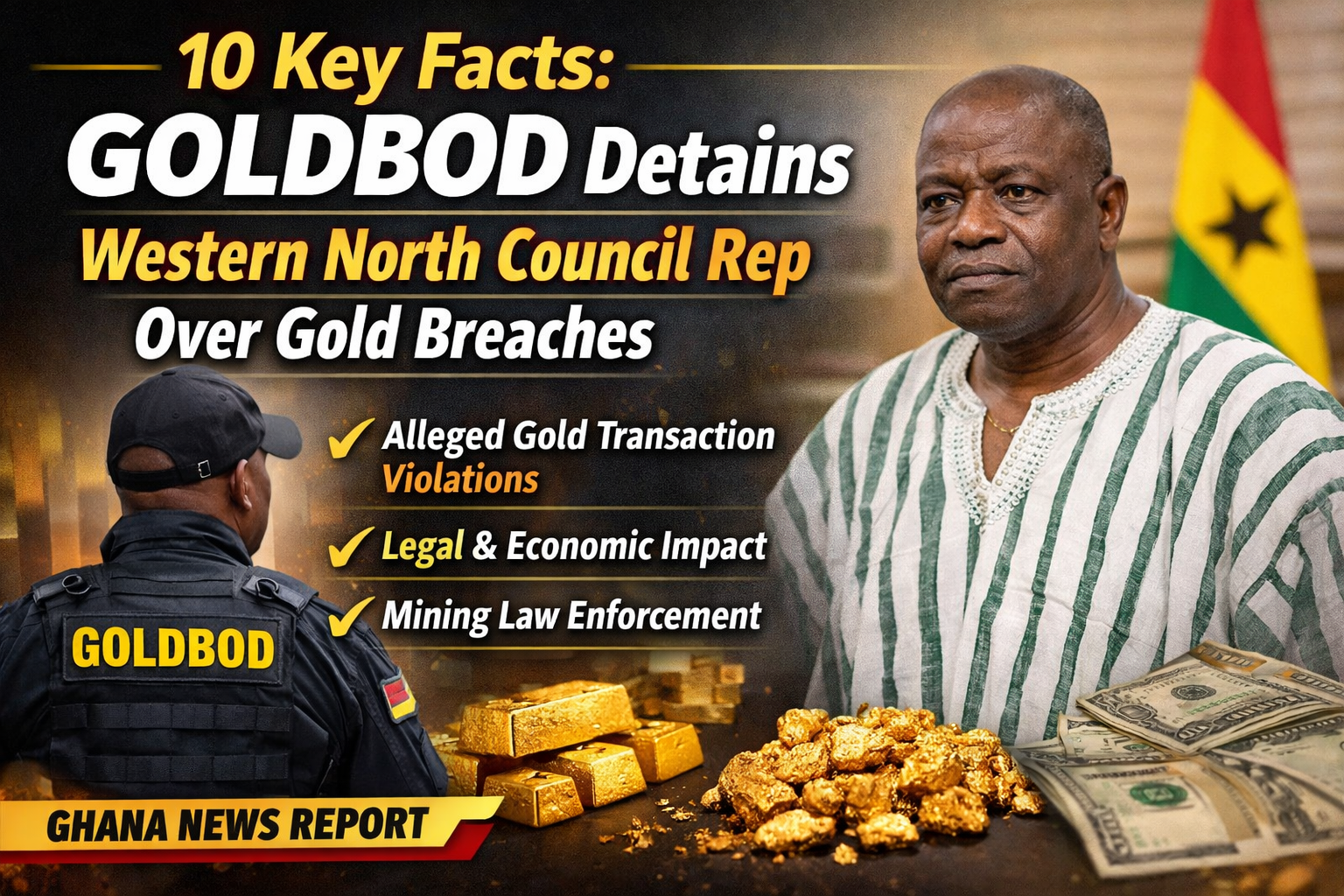
The GOLDBOD detains the Western North Council of State representative over gold transaction breaches, which has sparked national attention, raising serious concerns about regulatory compliance, illegal gold trading, and Ghana’s mineral governance framework. Authorities confirmed that the detention is linked to alleged violations involving unauthorised gold transactions, potential smuggling activities, and breaches of Ghana’s mining laws. The development highlights ongoing efforts to strengthen transparency, enforce gold export regulations, and curb illegal mining activities within the country’s lucrative gold sector.
Role of GOLDBOD in Gold Regulation
The case involving GOLDBOD detaining the Western North Council of State representative has brought renewed attention to the regulatory authority responsible for overseeing Ghana’s gold trade. Ghana Gold Board (GOLDBOD) plays a central role in supervising gold purchasing, licensing, export approvals, and compliance enforcement across the country.
As one of Africa’s leading gold producers, Ghana relies heavily on structured oversight to protect mineral revenues and prevent illegal transactions. GOLDBOD is tasked with ensuring that all gold buyers, exporters, and dealers operate within the framework of the Minerals and Mining Act. This includes verifying licences, monitoring transaction volumes, validating export documentation, and collaborating with customs officials to prevent smuggling.
The agency also works closely with financial intelligence and security institutions to detect suspicious trade patterns. In recent years, Ghana has intensified efforts to curb illegal gold trading, tax evasion, and unauthorised exports that result in revenue losses. Monitoring systems are designed to flag inconsistencies in declared quantities, export values, and compliance reports.
The development surrounding GOLDBOD detains the Western North Council of State representative, demonstrating the board’s authority to investigate and take action when potential breaches are detected. Regulatory enforcement does not distinguish between private traders and public officials, reinforcing the principle of accountability in the mining sector.
Beyond enforcement, GOLDBOD also supports policy development aimed at improving transparency and attracting responsible investment into Ghana’s gold industry. By maintaining strict oversight, the board helps sustain investor confidence, protect foreign exchange earnings, and ensure that gold exports contribute fairly to national development.
This case underscores the broader importance of regulatory governance in Ghana’s gold economy and highlights why GOLDBOD remains a key institution in safeguarding the country’s mineral resources.
Alleged Gold Transaction Breaches Explained
The development surrounding GOLDBOD detains Western North Council of State representative centers on alleged gold transaction breaches that may have violated Ghana’s mining and export regulations. Gold transaction breaches typically involve activities that bypass approved licensing systems, fail to meet reporting standards, or attempt to evade tax and royalty obligations tied to mineral sales.
Under Ghana’s mining framework, all gold buyers and exporters must obtain valid licenses, declare accurate transaction volumes, and process exports through authorized channels. Any deviation from these requirements can constitute a regulatory offense. In cases similar to GOLDBOD detains Western North Council of State representative, authorities often investigate discrepancies such as undeclared gold quantities, undervaluation of exports, or engagement with unauthorized intermediaries.
One of the most common breaches involves failing to properly document gold purchases before export. Accurate documentation ensures that royalties, corporate taxes, and export duties are correctly assessed. If documentation is incomplete or manipulated, it can lead to significant revenue losses for the state. Given that gold remains a major foreign exchange earner for Ghana, compliance with these procedures is critical.
Another potential violation may relate to unauthorized gold trading networks. Illegal gold transactions sometimes occur outside official channels, undermining government oversight and increasing the risk of smuggling. Regulatory agencies monitor transaction flows to detect unusual patterns, which can trigger formal investigations.
The case of GOLDBOD detains Western North Council of State representative suggests that investigators identified irregularities warranting further scrutiny. While full details have not been publicly confirmed, authorities are expected to review transaction records, licensing documentation, and export declarations to determine whether any laws were breached.
Ultimately, alleged gold transaction breaches are treated seriously because they affect national revenue, investor confidence, and the integrity of Ghana’s mineral governance system.
Legal Implications Under Ghana’s Mining Laws
The case of GOLDBOD detains Western North Council of State representative carries significant legal implications under Ghana’s mining and mineral governance framework. Ghana regulates gold exploration, purchasing, and export activities primarily through the Minerals and Mining Act, alongside other regulatory guidelines designed to ensure transparency and revenue protection.
Under Ghanaian law, any individual or entity involved in gold trading must possess valid licenses and comply strictly with reporting, taxation, and export requirements. Violations such as unauthorized gold purchases, false declarations, underreporting export values, or engaging in unlicensed trade can attract severe penalties. These penalties may include heavy fines, revocation of operating licenses, seizure of gold assets, or criminal prosecution depending on the severity of the breach.
The development involving GOLDBOD detains Western North Council of State representative indicates that authorities are treating the matter within the formal legal structure. Ghana Gold Board (GOLDBOD) has the mandate to investigate suspected breaches and refer cases for prosecution if sufficient evidence exists. Investigations typically involve reviewing transaction records, financial documentation, and compliance reports to determine whether the Minerals and Mining Act has been violated.
Importantly, Ghana’s legal system applies equally to public officials and private citizens. The involvement of a Council of State representative does not exempt the case from statutory procedures. If formal charges are filed, the matter would proceed through the courts, where evidence would be presented and assessed according to due process.
This situation underscores the seriousness of gold trade compliance in Ghana. Given the strategic importance of the gold sector to national revenue and foreign exchange earnings, enforcement of mining laws remains a priority. The outcome of GOLDBOD detains Western North Council of State representative could reinforce the country’s broader commitment to accountability and regulatory discipline within the mineral industry.
Political Sensitivity of the Case
The development surrounding GOLDBOD detains Western North Council of State representative carries significant political weight due to the high-profile position involved. The Council of State serves as an advisory body to the President of Ghana, providing counsel on governance, national policy, and constitutional matters. As such, any investigation involving a member of this body naturally attracts national attention and heightened public scrutiny.
The Council of State is recognized as an institution that embodies experience and leadership within Ghana’s democratic framework. Therefore, the detention linked to alleged gold transaction breaches raises broader concerns about accountability, transparency, and ethical conduct in public office. When senior public officials become subjects of regulatory investigations, the matter often extends beyond legal considerations into political and reputational territory.
The phrase GOLDBOD detains Western North Council of State representative underscores the seriousness of the situation. It also signals that regulatory enforcement bodies, including Ghana Gold Board (GOLDBOD), are prepared to act irrespective of political status. This approach aligns with Ghana’s ongoing efforts to strengthen anti-corruption measures and reinforce public trust in state institutions.
Politically sensitive cases can influence public perception of governance standards, particularly in sectors as economically vital as gold mining and export. Ghana’s gold industry contributes significantly to foreign exchange earnings, making compliance enforcement a national priority. Any breach involving influential figures could prompt calls for institutional reforms or tighter oversight mechanisms.
Ultimately, the case of GOLDBOD detains Western North Council of State representative highlights the intersection of politics, regulatory enforcement, and public accountability. The final outcome will not only determine legal consequences but may also shape broader conversations about integrity and transparency within Ghana’s leadership structures.
Political Sensitivity of the Case
The case of GOLDBOD detains Western North Council of State representative is politically sensitive due to the stature of the office involved. The Council of State functions as a constitutional advisory body to the President of Ghana, offering guidance on governance, national development, and state affairs. Any investigation involving a member of this body naturally draws intense public, media, and political scrutiny.
Because Council of State representatives are expected to uphold high ethical standards, allegations tied to gold transaction breaches elevate the matter beyond routine regulatory enforcement. The situation raises broader questions about transparency, public accountability, and compliance within Ghana’s mineral governance framework. In politically exposed cases, authorities must balance legal due process with public expectations for swift and impartial action.
The headline GOLDBOD detains Western North Council of State representative also signals that enforcement agencies, including Ghana Gold Board (GOLDBOD), are prepared to apply regulatory measures regardless of political influence. This reinforces the principle that mining laws and gold export regulations apply equally to all individuals, whether public officials or private sector actors.
Given that gold remains a cornerstone of Ghana’s economy, any controversy involving high-ranking officials can affect investor confidence and public trust in governance systems. Political opposition figures, civil society groups, and anti-corruption advocates often call for transparency in such cases to ensure institutional credibility is maintained.
Ultimately, the political sensitivity of GOLDBOD detains Western North Council of State representative lies not only in the alleged gold transaction breaches but also in the broader implications for governance standards. The outcome of the investigation may influence public discourse on ethical leadership, regulatory enforcement, and accountability within Ghana’s political landscape.
Impact on Ghana’s Gold Industry
The development surrounding GOLDBOD detains Western North Council of State representative could have broader implications for Ghana’s gold industry, which remains a cornerstone of the national economy. As one of Africa’s leading gold producers, Ghana depends heavily on gold exports for foreign exchange earnings, government revenue, and investor confidence.
High-profile investigations linked to gold transaction breaches often draw international attention, particularly from foreign investors and commodity traders who monitor regulatory stability. When enforcement actions involve politically exposed individuals, it reinforces the message that compliance standards are being strengthened. This can either reassure investors about regulatory seriousness or temporarily create uncertainty depending on how transparently the case is handled.
The phrase GOLDBOD detains Western North Council of State representative also highlights the government’s intensified efforts to combat illegal gold trading, tax evasion, and smuggling activities. Strong enforcement measures can improve long-term sector credibility by closing loopholes that allow revenue leakages. For a country where gold significantly contributes to GDP and foreign reserves, tightening compliance mechanisms supports sustainable economic growth.
At the same time, the case may prompt broader audits and reviews within the gold supply chain. Licensed dealers, exporters, and mining operators could face increased scrutiny as regulators aim to ensure full adherence to reporting and licensing standards. Such oversight may temporarily slow transaction processes but ultimately strengthens transparency within the sector.
Ghana Gold Board (GOLDBOD) plays a critical role in safeguarding the integrity of gold transactions. By enforcing compliance even in sensitive cases, the authority sends a signal that regulatory discipline remains central to Ghana’s mineral governance strategy.
In the long term, how the case of GOLDBOD detains Western North Council of State representative is resolved may shape perceptions of Ghana’s commitment to accountability and sustainable gold sector management.
Anti-Smuggling Efforts in Western North Region
The case of GOLDBOD detains Western North Council of State representative has renewed focus on anti-smuggling operations in Ghana’s Western North Region, an area known for significant gold mining activity. Due to its proximity to international borders and its concentration of small-scale mining operations, the region has faced ongoing challenges related to illegal gold trading and cross-border smuggling.
Ghana has intensified surveillance and enforcement measures in recent years to combat unauthorized gold exports. Regulatory agencies, including Ghana Gold Board (GOLDBOD), work alongside customs officials, security services, and financial intelligence units to track suspicious gold transactions. These efforts are designed to prevent revenue losses and ensure that all exported gold passes through approved channels.
Gold smuggling typically involves bypassing licensed buying agents, underreporting quantities, or transporting gold across borders without proper documentation. Such activities deprive the government of royalties, taxes, and export duties. In response, authorities have strengthened border checks, increased transaction monitoring, and implemented stricter documentation verification systems.
The headline GOLDBOD detains Western North Council of State representative highlights the seriousness of regulatory enforcement within this high-risk region. It also underscores the government’s broader strategy to clamp down on illegal mining networks and unauthorized gold trade operations.
Anti-smuggling campaigns are not only about revenue protection; they also aim to enhance Ghana’s international reputation as a responsible gold exporter. Transparent enforcement builds confidence among foreign investors and trading partners who rely on regulatory integrity.
As investigations continue, the Western North Region remains under close watch, reinforcing the importance of strict compliance and oversight within Ghana’s gold supply chain.
Financial and Economic Implications
The case of GOLDBOD detains Western North Council of State representative carries significant financial and economic implications for Ghana’s mineral sector. Gold remains one of the country’s largest sources of foreign exchange earnings and government revenue. Any breach involving unauthorized transactions, tax irregularities, or export violations can directly affect national income streams.
Ghana relies heavily on royalties, export duties, and corporate taxes generated from gold production and trade. When gold transactions bypass official channels, the government may lose substantial revenue that would otherwise contribute to infrastructure, public services, and economic development. Strengthening enforcement helps reduce these leakages and stabilize fiscal performance.
The headline GOLDBOD detains Western North Council of State representative also signals tighter oversight within the gold value chain. While short-term investigations can create temporary uncertainty, long-term regulatory discipline often improves investor confidence. International buyers and financial institutions prefer markets with transparent compliance systems, particularly in high-value commodity sectors.
Additionally, illegal gold trade can distort official export statistics and foreign exchange reserves. Accurate reporting ensures that central financial authorities can properly manage currency stability and trade balances. Enforcement actions led by Ghana Gold Board (GOLDBOD) aim to safeguard these macroeconomic fundamentals.
From an economic governance perspective, high-profile cases reinforce accountability mechanisms within the mineral sector. When compliance standards are consistently applied, it strengthens Ghana’s reputation as a responsible gold-producing nation.
Ultimately, the financial impact of GOLDBOD detains Western North Council of State representative will depend on the final investigation outcome. However, the case highlights the broader importance of regulatory integrity in protecting national revenue and sustaining economic stability within Ghana’s gold industry.
Public Reaction and Transparency Concerns
The headline GOLDBOD detains Western North Council of State representative has generated strong public reaction across Ghana’s political and economic landscape. Civil society organizations, anti-corruption advocates, and mining sector stakeholders have called for a transparent and impartial investigation to ensure accountability. Given the senior public office involved, many citizens expect full disclosure of findings once the inquiry concludes.
In Ghana, issues related to gold transactions and mineral governance often attract intense scrutiny because of the sector’s importance to national revenue. Public confidence in regulatory institutions depends largely on how fairly and consistently laws are enforced. When high-profile individuals are investigated, transparency becomes even more critical to maintaining trust.
The phrase GOLDBOD detains Western North Council of State representative has fueled debate on social media and in mainstream news platforms. Some members of the public applaud the move as evidence that no individual is above the law. Others emphasize the importance of due process, cautioning against premature conclusions before formal charges are filed or court proceedings begin.
Transparency concerns also extend to how investigative details are communicated. Clear updates from authorities, including Ghana Gold Board (GOLDBOD), can help prevent misinformation and protect the integrity of the legal process. Effective communication strengthens institutional credibility and reassures investors, partners, and the broader public.
Ultimately, public reaction to GOLDBOD detains Western North Council of State representative reflects broader expectations for ethical leadership and responsible mineral sector governance. The final outcome of the case may influence long-term perceptions of accountability and transparency within Ghana’s gold industry.
What Happens Next?
Following the development that GOLDBOD detains Western North Council of State representative, the next phase will depend on the outcome of the ongoing investigation. Ghana Gold Board (GOLDBOD), in collaboration with security and legal authorities, is expected to complete a thorough review of transaction records, licensing documentation, financial statements, and export declarations tied to the alleged gold transaction breaches.
If sufficient evidence is established, formal charges may be filed under Ghana’s mining and financial regulations. The case could then proceed through the judicial system, where prosecutors would present evidence and the accused would have the opportunity to mount a legal defense. Ghana’s legal framework ensures due process, meaning no final determination will be made without court review if prosecution occurs.
If investigations reveal administrative lapses rather than criminal wrongdoing, regulatory sanctions such as fines, compliance directives, or license reviews may be imposed instead of criminal penalties. In some cases, investigations can also lead to broader audits within the gold supply chain to strengthen oversight mechanisms.
The phrase GOLDBOD detains Western North Council of State representative underscores the seriousness of enforcement within Ghana’s gold sector. The final outcome may influence future policy reforms, particularly in areas related to gold export monitoring, licensing verification, and anti-smuggling enforcement.
Beyond the legal dimension, the case could shape public confidence in governance institutions and regulatory bodies. A transparent conclusion—regardless of the verdict—will be crucial in reinforcing accountability standards within Ghana’s mineral industry.
Ultimately, what happens next will depend on evidence, legal procedures, and regulatory findings, but the case has already become a significant benchmark for compliance enforcement in Ghana’s gold trade sector.
Other stories
No Prima Facie Case Ruling: EC Removal Petition Dismissed Under Ghana Constitutional Law
Breaking News: Ghana Privacy Scandal Sparks International Arrest Action
10 Shocking Facts About the Yaytseslav Viral Hotel Video Controversy
Antoine Semenyo Equals Manchester City Record – Premier League Milestone vs Tottenham
Nigel Gaisie’s prediction regarding Agradaa’s sentence reduction on December 31 has come true.
About the Author